Waterproofing
Waterproofing & Leak Detection
Track down where water enters, then seal the envelope so the building stays dry.
In short
What is waterproofing?
Waterproofing is the combination of membranes, coatings, sealants and flashings that keeps water out of a building's concrete and its interior spaces. Any concrete exposed to rain, soil or standing water needs it, including roofs, balconies, planters, plaza and pool decks, facade joints and walls below grade. Leaks, white salt deposits, split sealant and ponding tell you an existing system is near the end of its service life.
Free milestone planner
Is a milestone inspection coming due on your building?
Enter the year your building got its certificate of occupancy and how many stories it has. The planner estimates your deadline under Florida law, then you can send it to SERPE-CO for a second look.
Add the year and story count for an estimated due date.
Want a second look at your timeline? Send your building details and SERPE-CO will follow up about the inspection, likely repairs and how to plan for them.
About this estimate
This is a planning estimate drawn from the statewide rule in Florida Statute 553.899. Your local building department sets the real deadline and may call for the first inspection at 25 years instead. Broward County also has its own Building Safety Inspection Program. Check your date with your building official and engineer, or contact SERPE-CO and we will help you sort it out.
Waterproofing
Most concrete damage in South Florida begins as a leak. SERPE-CO traces water back to where it enters, then installs the system that suits each surface: below-grade walls, roofs, planters, balconies and facade joints.
With more than 20 years in the field, SERPE-CO handles waterproofing work from St. Lucie to Miami-Dade for condominium associations, property managers and owners of commercial buildings.
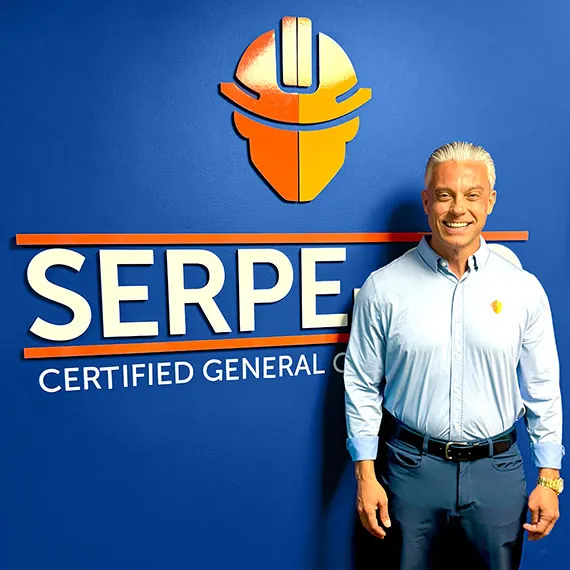
Reviewed by Brett Serpe, MBA, GC, CEO of SERPE-CO · Florida Certified General Contractor CGC #1523974
Prepared by the SERPE-CO project team, with more than 20 years in concrete restoration. Last reviewed November 2026.
Why it happens
How South Florida rain gets inside buildings
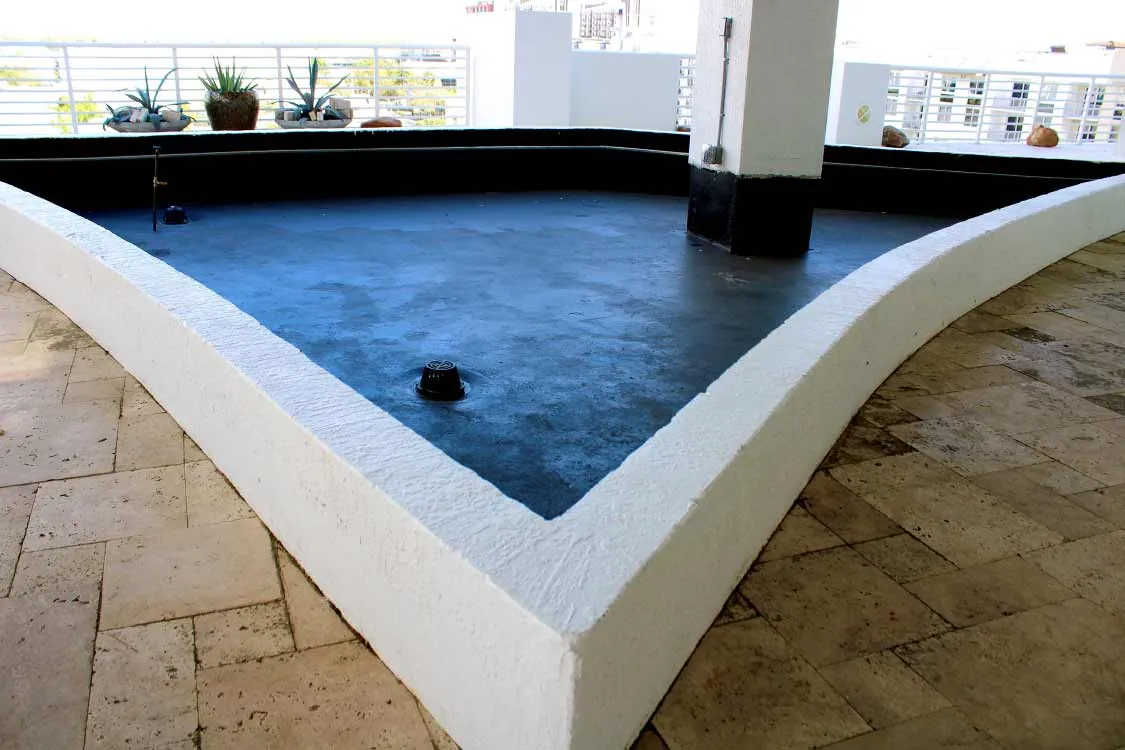
No concrete building is truly watertight. Concrete is full of tiny pores, it cracks as it cures and shifts, and every building has dozens of joints where one material butts into another. South Florida piles on downpours, wind that pushes rain sideways into walls and openings, a shallow water table and salt in the air. Sealants and membranes, the layers meant to keep water out, sit in heavy sun and heat that stiffen and crack them long before the structure itself is worn.
Leaks seldom show up where the water got in. Water runs along the slab, the steel or a conduit and surfaces on a wall or ceiling some distance away. Along the way it brings chloride to the reinforcing, dissolves minerals that later appear as efflorescence, and feeds mold behind drywall and finishes. Below-grade walls, planters and pool decks keep water pressed against the structure all the time, so a small flaw there causes more damage than the same flaw on a wall that dries out between storms.
The work
Waterproofing: what the job covers
- 01Water testing to trace leaks
- 02Sheet and liquid-applied membrane systems
- 03Pool deck, plaza and balcony waterproofing
- 04Below-grade and planter waterproofing
- 05New sealants and expansion joints
- 06Door and window perimeter sealant
How we do it
Tracing the leak first, and then sealing up the envelope
We find the cause before we pick a product. Our team looks at where and when the leak shows up, checks the surfaces above and beside it, then tests in order, wetting a single part of the building at a time, starting low and moving up, until the path is pinned down. Flood tests on decks and planters, spray tests at window perimeters and moisture readings each answer a separate question. A system is chosen only once the path is confirmed.
How long a system holds up comes down to the prep. The crew cuts out old sealant, scrapes off failed coatings, routes the cracks, and cleans and profiles the concrete to the manufacturer's standard, then checks moisture. In moving joints, backer rod goes in at the right depth so the sealant grips just the two faces of the joint and can stretch. Ponding is corrected with slope, and every transition at walls, drains, thresholds and penetrations is detailed with fabric or flashing before the main membrane goes on.
Liquid membranes go on at the wet film thickness listed on the data sheet, and the crew checks it with a gauge as they work. Sheet membranes are lapped, rolled and mechanically terminated wherever the system calls for it. Planter and below-grade systems get drainage and protection board before the soil goes back, and drains and weep holes are kept clear. When we can, we flood test the finished membrane before tile, pavers or soil cover it, since that is the last easy chance to catch a pinhole.
Materials we use
Which membrane goes where: polyurethane, PMMA, cementitious and sheet systems
Restoration work leans on liquid-applied membranes because they cure into one continuous layer with no laps. Polyurethane is the all-round choice for decks and balconies. PMMA sets fast, wraps around awkward penetrations well and often gets chosen for roofs, planters and areas that cannot be closed long. Cementitious coatings stick to damp concrete and hold back water pushing from behind, so they suit tanks, fountains and the inner face of below-grade walls. Under pavers and plantings on plaza decks, the usual choices are hot rubberized asphalt or a cold fluid-applied system.
Sheet membranes, whether self-adhered or torched down, come with a thickness controlled at the factory and are common on foundation walls and beneath topping slabs, although every lap is a possible leak. Sealants are picked joint by joint: silicone for facade and glazing joints that face years of sun, polyurethane for joints that get painted or walked on, and hybrids where compatibility is in doubt. Active leaks are stopped by injecting chemical grout, usually polyurethane. The right waterproofing system comes down to substrate, exposure, movement and whatever covers it.
Built to hold up
Where membranes usually fail, and what to ask before the membrane gets covered up
The open middle of a deck is rarely where a membrane gives out. Failures cluster at terminations, drains, penetrations, door thresholds and corners where the surface changes direction. Careful installers reinforce every transition with fabric or a preformed flashing piece and use sealant joints with the right width-to-depth ratio and a primer suited to the substrate. Moisture trapped in the slab is the other usual culprit behind blisters and lost bond, so moisture testing and the cure time required for new concrete are steps nobody should skip.
A waterproofing proposal should name the manufacturer and system for every surface, the preparation standard, the target thickness and how that thickness will be checked. Ask whether the installer holds that manufacturer's approval, since many warranties depend on it, and whether the membrane will be flood tested or scanned with electronic leak detection before it is buried. While work is underway, look for wet film readings, adhesion tests and photos of the details. The manufacturer sets the warranty terms.
How we run a job
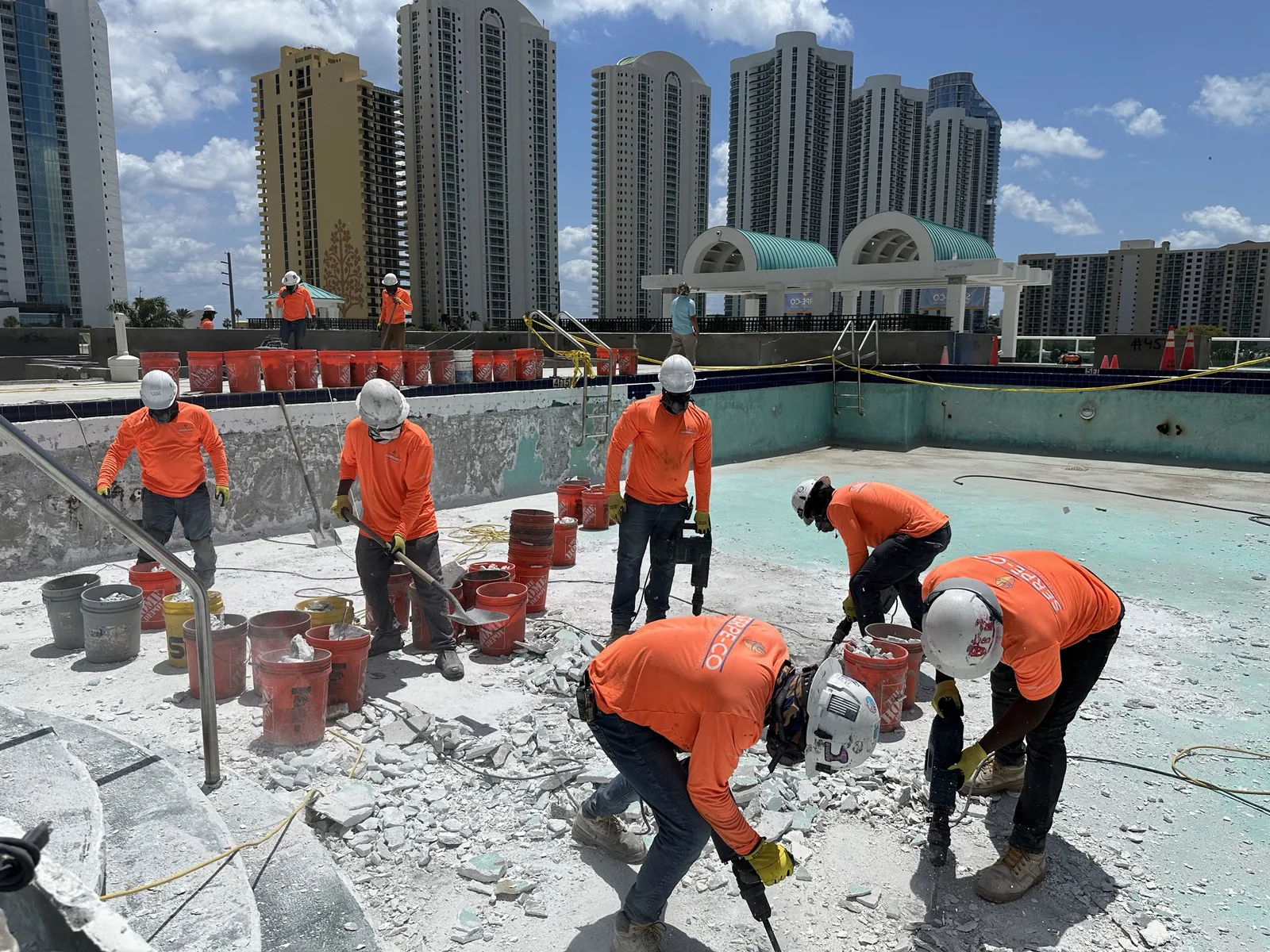
Scheduled around the residents and staff who use the building.
- 01
Meet on site
Each job starts on site, walking the property and its conditions with your manager, board or engineer.
- 02
Follow the engineer's scope
The engineer writes the scope. We price it line by line, plan access and lay out each phase to build it.
- 03
Put safety first
We can never work too safely: shoring, swing stages, barricades and notices go up first.
- 04
Build the repairs
Crews work through the repairs in order, stopping for inspections wherever the engineer calls for them.
- 05
Finish and document
Final inspections, a closed permit and a full record of the work for the association.
Counties we cover
Waterproofing, county by county
Summary
Waterproofing: what to remember
- 01
Waterproofing tends to fail at drains, thresholds, penetrations and edges, far more often than across the open membrane field.
- 02
Polyurethane, PMMA, cementitious and sheet membranes each fit different surfaces, and the data sheet from the manufacturer spells out where each one belongs.
- 03
Sealants are matched to each joint: silicone where facade joints face the sun, polyurethane for joints that will be painted or see foot traffic.
- 04
A flood test before tile, pavers or soil go over a deck is the last realistic chance to catch a pinhole.
Glossary
Words that show up in an engineer's report
- Hydrostatic pressure
- The push of standing or ground water against a slab or wall, which below-grade waterproofing must resist without a break.
- Backer rod
- A squeezable foam cord pressed into a joint before sealing, which sets sealant depth and keeps the sealant from bonding to the joint back.
- Flood test
- A check where a deck or planter is dammed and flooded with shallow water for a set time while someone watches the space below for leaks.
- Termination bar
- A metal or plastic strip screwed over the upper edge of a membrane, pinning it tight to the wall, with a sealant bead run along the top.
- Negative-side application
- A treatment placed on the dry interior face of a wall or slab, away from where water enters, for cases where the wet face cannot be reached from outside.
Questions
Waterproofing: questions boards ask
How do you track down where a leak starts?
We start by asking how the building has behaved, then walk it closely. Suspect areas get controlled water tests and moisture readings. Water can travel far between where it gets in and where it shows, so we prove the path before recommending a fix.
How many years will waterproofing membranes last?
Each system lasts a different length of time depending on its exposure and upkeep. A membrane buried under pavers or tile stays out of the sun but cannot be looked at, while an exposed deck coating wears faster but can be recoated. Every product's expected life is listed in its data sheet and warranty, and regular inspection stretches it.
Can we stop a leak from the inside?
In some cases. On below-grade walls, a water-reactive resin can often be injected from inside into cracks and joints, where it expands and closes the path. The leak stops at that spot, but the concrete behind it stays wet. When the exterior face can be reached, sealing the side where water comes in is usually the longer-lasting fix.
How is a sealer different from a coating or a membrane?
A penetrating sealer is absorbed into the concrete and repels water without leaving a film, which means it cannot span cracks. A coating leaves a thin film that sheds rain and stands up to weather. A membrane is thicker and flexible, built to stay watertight over cracks and under ponded water. Decks above occupied rooms generally need a membrane.
Does a planter sitting on a plaza deck need separate waterproofing?
Yes. Wet soil presses on planter concrete permanently and roots find any gap. A typical lining is a root-resistant membrane, protection board and drainage layer, with weeps kept open, tied into the deck membrane. SERPE-CO handles planters within its pool deck projects, from soil removal and drainage to the new lining.
Do owners need to leave during the work?
Rarely. Residents stay home while crews move through the building by elevation or stack. Each balcony is closed only during its own repair, and owners hear from us before anything affects them. The board and manager approve the sequence and access plan first.
Will you coordinate with our engineer?
Always. SERPE-CO works closely with associations and professional engineers, building every structural repair to the engineer of record's specification and lining up their inspections as the job goes. No engineer yet? We can help you take the first step.
Industry standards and guides
- International Concrete Repair Institute (ICRI): repair guidelines for concrete
- American Concrete Institute (ACI): codes and guides for concrete construction and repair
- Florida Building Code
On every project, our repair methods and materials follow the engineer's specification, the product maker's requirements and the current building code. Treat this page as general information, not engineering advice.
Other services we provide
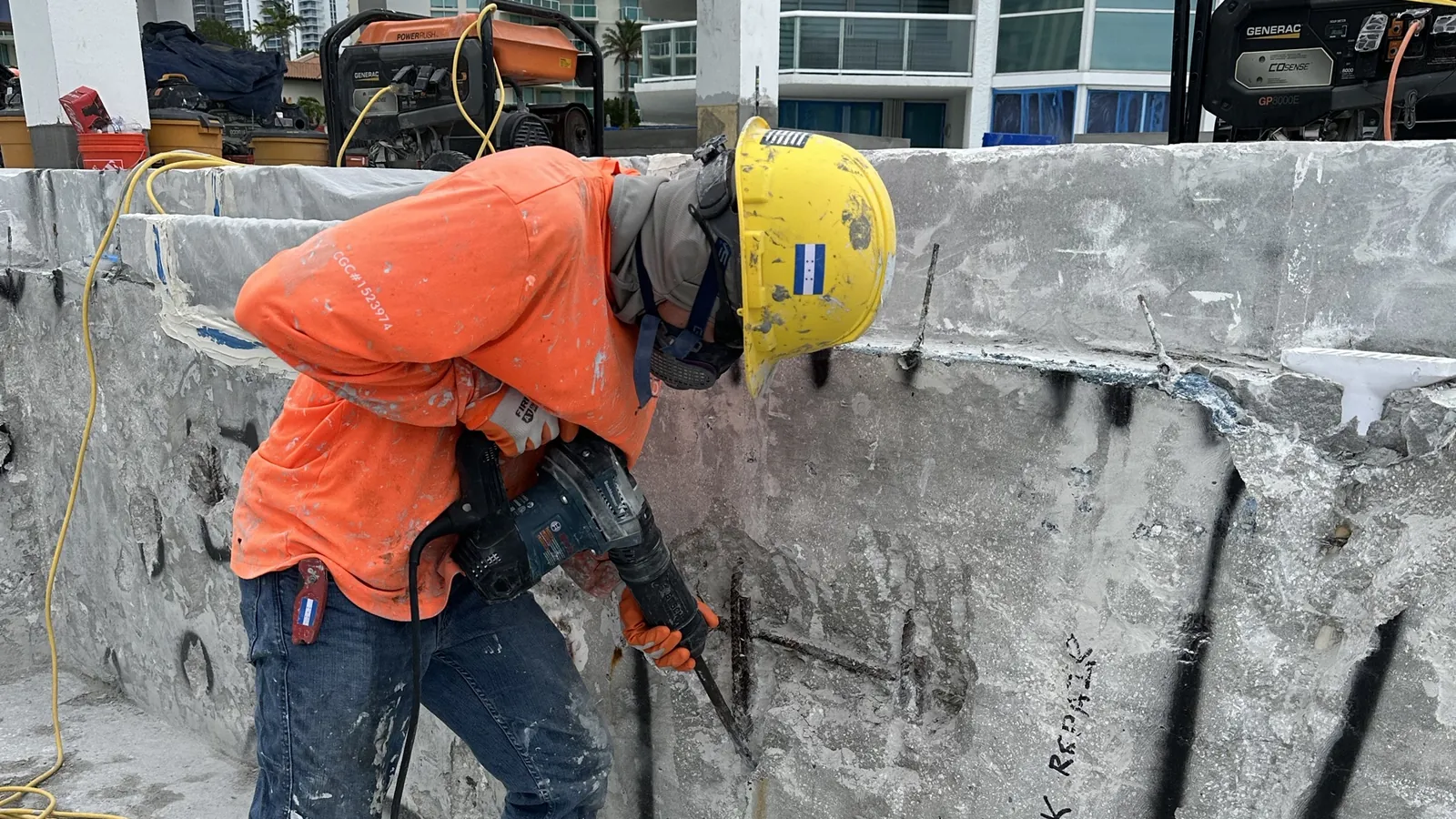 Concrete Restoration
Spalled concrete and rusted rebar, fixed exactly as your engineer specifies.
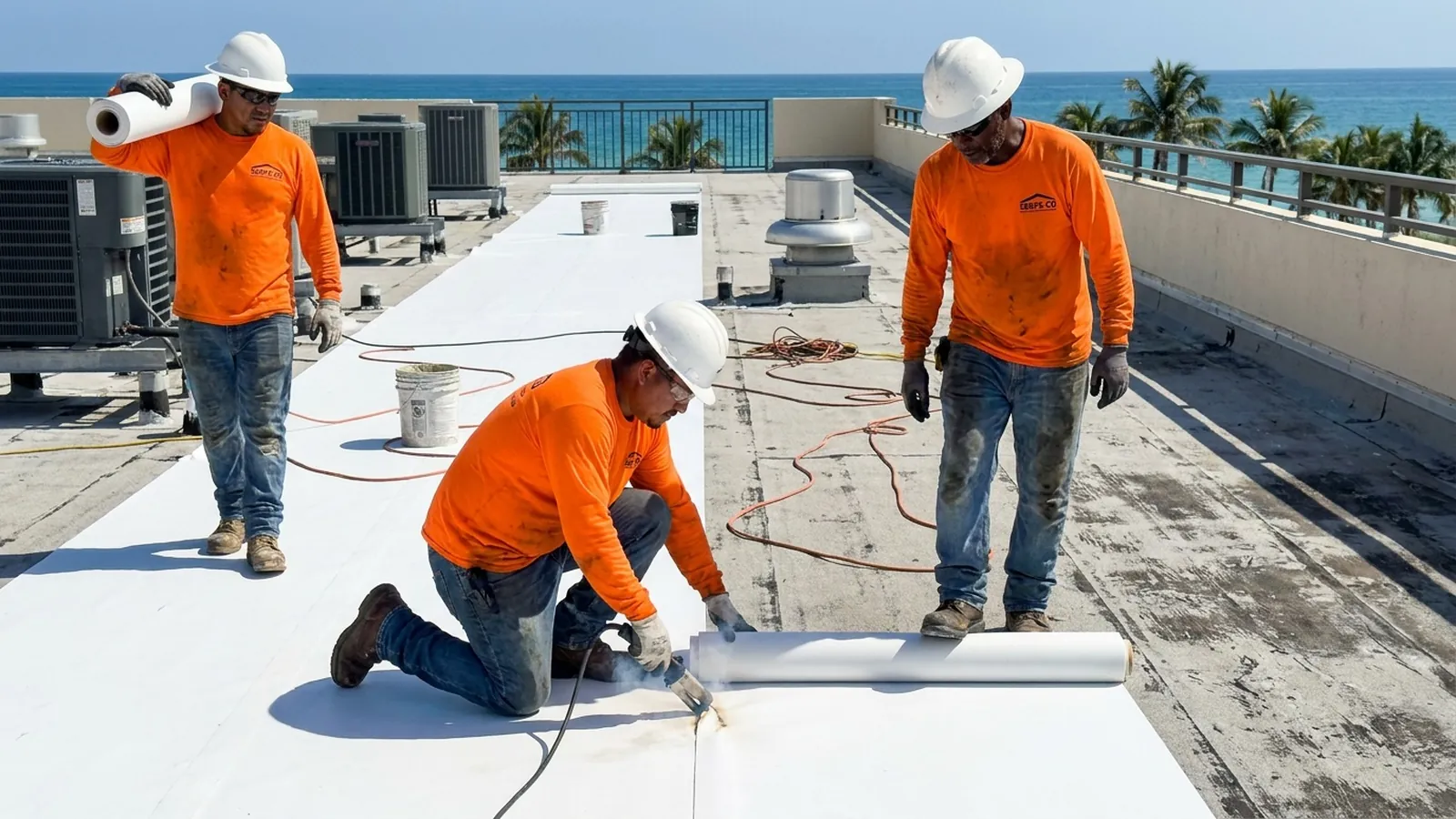 Commercial Roofing
Low-slope roofs repaired, recoated or replaced per the consultant's spec, once the deck below is sound.
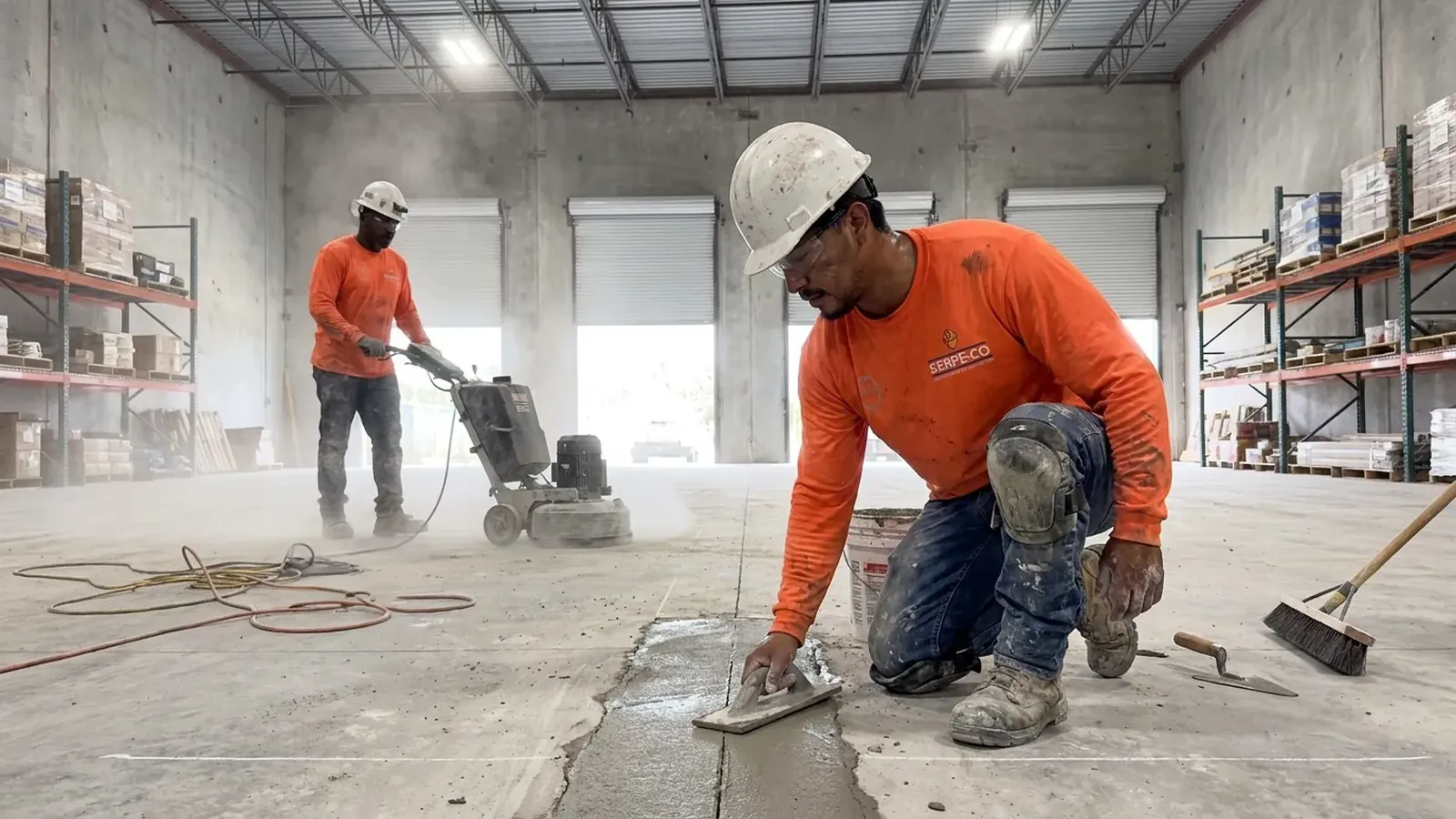 Industrial Floors
Flat new slabs, joints built for forklift traffic and finishes made to last.
Working with an engineer?
Holding drawings, specifications or a complete set of bid documents?
Structural engineers, property engineers and board members send SERPE-CO much of our restoration, pool and roofing work. Once a scope has been drawn and specified, our team prices what the documents show, raises questions where something is unclear, and lays out each line so boards can weigh the bids on equal terms.
Request an estimate
Let's plan your restoration.
Tell us where the building is and what you are seeing. We set up a visit to the property, then send a written proposal, or tell you an engineer needs to write the scope first.
- More than 20 years in the field
- St. Lucie, Martin, Palm Beach, Broward and Miami-Dade
- Family-owned Certified General Contractor
Rather call?(954) 718-3094