Stucco & Painting
Stucco, Facade Repair & Exterior Painting
Repair the wall first, then apply a paint system that keeps water out.
In short
What is stucco and painting?
Stucco & painting work repairs the cement plaster skin of a building and then applies a fresh protective coating system. Loose stucco comes off, cracks get repaired, failed sealant is replaced and the walls are recoated. The usual triggers are a facade that sounds hollow, cracks that keep spreading, a chalky film on the paint, or wind-driven rain reaching the inside.
Free milestone planner
Is a milestone inspection coming due on your building?
Enter the year your building got its certificate of occupancy and how many stories it has. The planner estimates your deadline under Florida law, then you can send it to SERPE-CO for a second look.
Add the year and story count for an estimated due date.
Want a second look at your timeline? Send your building details and SERPE-CO will follow up about the inspection, likely repairs and how to plan for them.
About this estimate
This is a planning estimate drawn from the statewide rule in Florida Statute 553.899. Your local building department sets the real deadline and may call for the first inspection at 25 years instead. Broward County also has its own Building Safety Inspection Program. Check your date with your building official and engineer, or contact SERPE-CO and we will help you sort it out.
Stucco & Painting
Painting over a failing wall means paying twice. We sound the facade, remove loose stucco, fix cracks, reseal joints and apply a coastal Benjamin Moore or Sherwin-Williams system. Boards see color overlays of the building first.
With more than 20 years in the field, SERPE-CO handles stucco & painting work from St. Lucie to Miami-Dade for condominium associations, property managers and owners of commercial buildings.

Reviewed by Brett Serpe, MBA, GC, CEO of SERPE-CO · Florida Certified General Contractor CGC #1523974
Prepared by the SERPE-CO project team, with more than 20 years in concrete restoration. Last reviewed November 2026.
Why it happens
How stucco walls crack, come loose and leak
Stucco is a thin coat of cement plaster bonded over concrete or block, and it moves differently from the wall underneath. Daytime heat, night cooling, shrinkage and slight structural movement all leave hairline cracks, most often at window and door corners and at the seam between block infill and the concrete frame. Wind-driven rain gets into those cracks. When water sits behind the plaster, the bond lets go, the layer separates, and the wall starts to bulge and sound hollow.
Paint is the first waterproof layer on the wall, and the sun wears it away. UV attacks the binder, so the film chalks, thins and loses the stretch it needed to span fine cracks. Sealant joints around windows go hard and pull loose. Where the building has a reinforced concrete frame, a rust stain or a straight-line crack in the stucco often marks rusting steel below, so a facade survey has to tell surface problems apart from structural ones.
The work
Stucco & Painting: what the job covers
- 01Stucco sounding, removal and new application
- 02Cracks routed, sealed and patched
- 03Surface prep and pressure washing
- 04High-build and elastomeric exterior paints
- 05New sealant at joints, windows and doors
- 06Swing stage, scaffolding or lift access
How we do it
Our process for facade repair and repainting
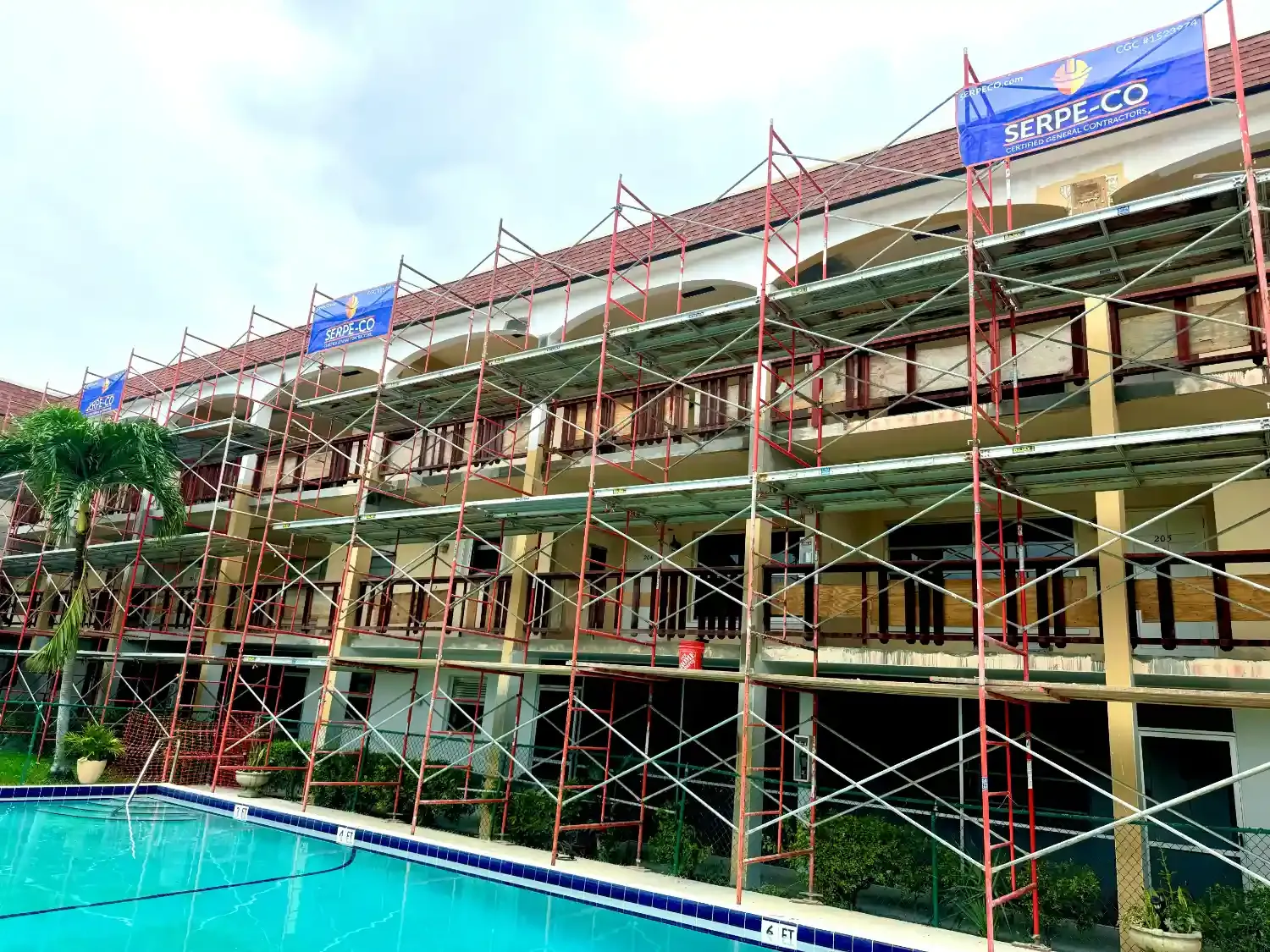
Every drop of the facade gets sounded, working from a swing stage, lift or scaffold. Our crew marks the hollow spots and cuts them back to firm edges. Damaged concrete or block behind the stucco is repaired first, following the engineer's detail. The new plaster is applied in coats over a bonding agent, with lath added when the specification requires it, and each coat cures before the next. The final coat is textured to blend with the wall around it.
Crack treatment depends on width and movement. A fine crack is normally covered with an elastomeric patching compound, while a wider or moving one is routed out and sealed. Around windows, doors and control joints, the crew removes the old sealant and installs new sealant over backer rod. Next the whole wall is pressure washed to strip chalk, mildew and loose paint, then left to dry. Fresh cement is very alkaline, so new stucco needs its full cure before any coating goes on.
Painting begins with the right primer or sealer for the surface, and an alkali-resistant one over fresh patches. Coat count and film thickness follow the manufacturer's system, because an elastomeric finish only spans cracks when it is built up thick enough. Back-rolling works the paint into the stucco texture and seals pinholes. We paint one drop at a time in good weather and check each elevation before moving the stage. We also provide color overlays of the building so the board can compare schemes.
Materials we use
Stucco mixes, sealants and paint systems for the coast
Stucco repair uses portland cement plaster, either mixed in the field from cement, lime and sand or bought as a pre-blended, polymer-modified patch mix with more predictable behavior. Over block and concrete, a dash coat or bonding agent gives the plaster something to grab. On framing or mixed substrates, the plaster goes over corrosion-resistant lath with accessories like casing beads and control joints. Close to the water, non-metallic or galvanized lath and accessories are the better choice, since plain steel trim rusts and bleeds through the finish.
Coatings are matched to the wall's condition. All-acrylic paint breathes and keeps its color on sound stucco, elastomerics build a thick, stretchy film over walls with hairline cracks, and silicone-based finishes repel rain while letting vapor out. In a humid climate a film that traps moisture will blister. SERPE-CO works with leading paint suppliers such as Benjamin Moore and Sherwin-Williams, keeps primer, patch, sealant and finish within one manufacturer's system, and prepares color overlays of the building so the board can compare schemes.
Built to hold up
Why some paint jobs last for years and others peel
On stucco, a failed coating nearly always traces back to preparation. Paint over mildew, salt, chalk or loose material bonds to that layer, not to the wall, and fresh plaster coated before it cures and loses its alkalinity can burn the finish. Good work sounds every elevation, pressure cleans, checks patches for pH and moisture, and applies the specified primer and finish at the spread rate that reaches the required dry film thickness. Near the coast paint is the waterproofing layer, so plan to repaint about every 7 to 10 years.
A clear facade proposal breaks the stucco & painting scope into items you can measure: square feet of hollow plaster, linear feet of cracks and sealant joints, and the coating for each elevation. Find out which joints are being resealed, the film thickness the specification calls for and how it is verified, and how plants, cars and windows will be covered. Many manufacturers will inspect the prep and back their full system with a written warranty. Get that document in hand before work begins.
How we run a job
Scheduled around the residents and staff who use the building.
- 01
Meet on site
Each job starts on site, walking the property and its conditions with your manager, board or engineer.
- 02
Follow the engineer's scope
The engineer writes the scope. We price it line by line, plan access and lay out each phase to build it.
- 03
Put safety first
We can never work too safely: shoring, swing stages, barricades and notices go up first.
- 04
Build the repairs
Crews work through the repairs in order, stopping for inspections wherever the engineer calls for them.
- 05
Finish and document
Final inspections, a closed permit and a full record of the work for the association.
Counties we cover
Stucco & Painting, county by county
Summary
Stucco & Painting: what to remember
- 01
A paint job can only last as long as the stucco behind it, so cracks, salt, chalk and mildew are dealt with first.
- 02
An elastomeric coating spans hairline cracks only at the dry film thickness its manufacturer calls for.
- 03
Fresh stucco patches need time to cure and lose alkalinity before painting, otherwise the finish may stain and let go.
- 04
SERPE-CO prepares color overlays of the building so a board can compare paint schemes before choosing one.
Glossary
Words that show up in an engineer's report
- Sounding
- Tapping stucco with a small hammer to hear a dull, hollow note, which shows where the plaster has come loose from the wall behind it.
- Dry film thickness
- How thick a coating is once fully cured, normally given in mils. That figure controls how well an elastomeric finish spans cracks and keeps rain out.
- Chalking
- A powdery residue that builds on old paint as sunlight breaks down its binder. Heavy chalking has to be cleaned off or sealed before any recoat.
- Control joint
- A formed line in a stucco wall that splits it into panels, giving shrinkage and heat movement a planned spot to crack rather than a random one.
- Lath
- Metal or non-metallic mesh fastened over framing or mixed surfaces, which gives stucco a mechanical grip where it cannot bond straight to the material underneath.
Questions
Stucco & Painting: questions boards ask
Why does stucco repair come first?
Paint is the building's first waterproofing layer, and it only works on a dry, solid wall. Loose stucco and open cracks let water behind new paint to blister it. Repairing the wall first makes the paint last.
How often should we repaint a coastal building?
No fixed rule applies, though coastal buildings often need repainting every 7 to 10 years. Coating life comes down to the product, how thick it went on, sun and salt, and the wall beneath. Chalking, fading, fine cracking and failed sealant joints are the warning signs. Many warranties run a set term, so a facade review near its end makes sense.
How is an elastomeric coating different from a regular exterior acrylic paint?
Elastomeric coatings go on much heavier and stay flexible, so they can bridge fine cracks and still shed wind-driven rain. Standard acrylic paint leaves a thinner film that is mostly about color and weather protection. The right choice for a building comes down to the condition of its walls and the manufacturer's system recommendation.
Can a South Florida building be painted during the rainy season?
Yes, if the job is planned around the weather. Paint needs a dry wall and time to cure before a shower, so crews check the forecast, work the elevations that dry soonest first and pack up early when afternoon storms are coming. Patched and pressure-washed walls get time to dry out before coating. Temperature, humidity and recoat limits come from the manufacturer's data sheet.
Why do fine cracks return after a building gets repainted?
Hairline cracks come back when the wall keeps moving or the paint is too thin or too stiff to stretch over them. Movement concentrates at window corners and along block-to-frame joints, which shift with daily heat. The fix is to treat those cracks with a flexible filler or sealant first and then build an elastomeric coating to its full specified thickness.
Do owners need to leave during the work?
Rarely. Residents stay home while crews move through the building by elevation or stack. Each balcony is closed only during its own repair, and owners hear from us before anything affects them. The board and manager approve the sequence and access plan first.
Will you coordinate with our engineer?
Always. SERPE-CO works closely with associations and professional engineers, building every structural repair to the engineer of record's specification and lining up their inspections as the job goes. No engineer yet? We can help you take the first step.
Industry standards and guides
- International Concrete Repair Institute (ICRI): repair guidelines for concrete
- American Concrete Institute (ACI): codes and guides for concrete construction and repair
- Florida Building Code
On every project, our repair methods and materials follow the engineer's specification, the product maker's requirements and the current building code. Treat this page as general information, not engineering advice.
Other services we provide
 Industrial Floors
Flat new slabs, joints built for forklift traffic and finishes made to last.
 Milestone & Recertification
We take the engineer's report through to permit closeout, on a timeline the board can plan for.
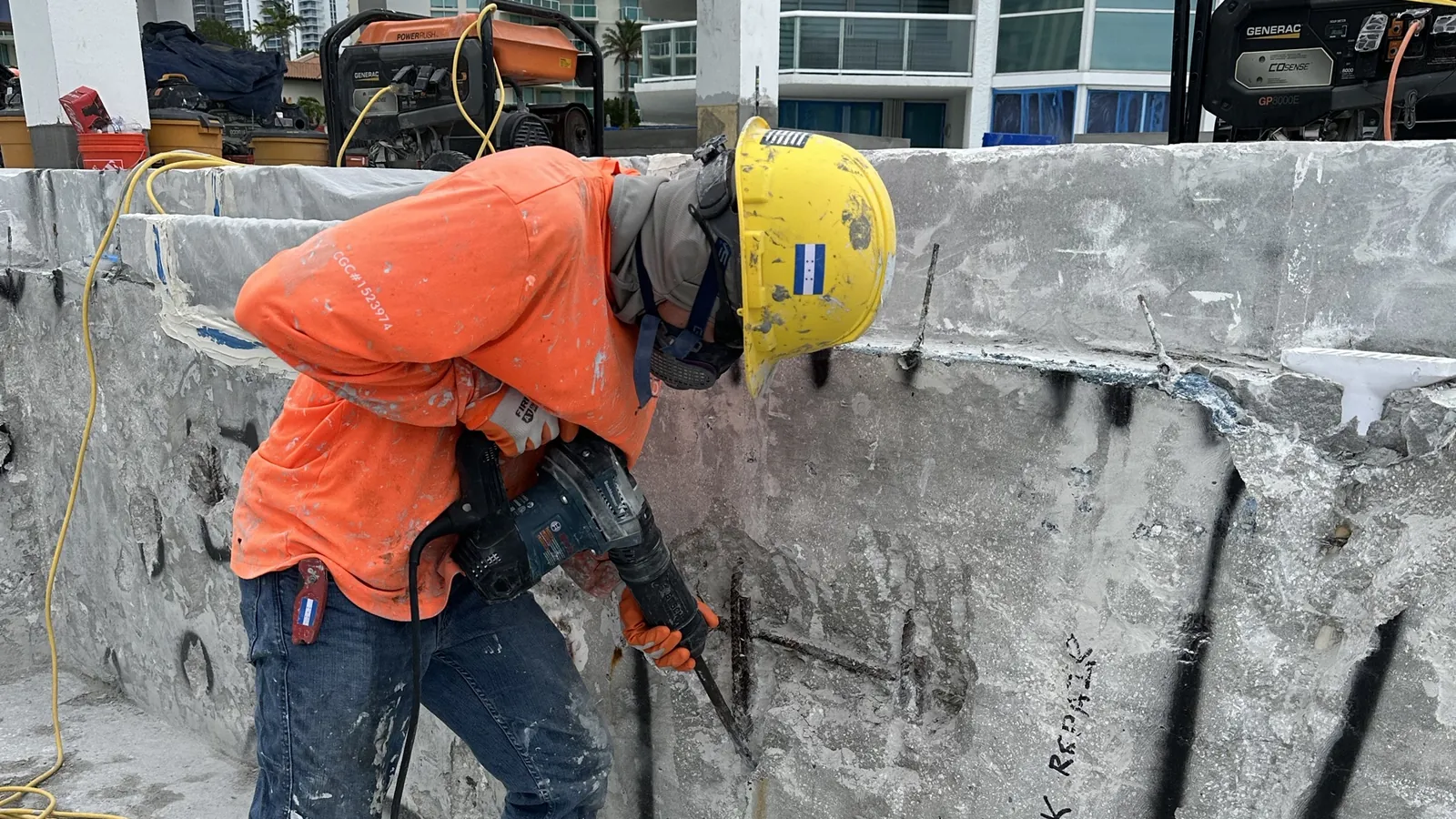 Concrete Restoration
Spalled concrete and rusted rebar, fixed exactly as your engineer specifies.
Working with an engineer?
Holding drawings, specifications or a complete set of bid documents?
Structural engineers, property engineers and board members send SERPE-CO much of our restoration, pool and roofing work. Once a scope has been drawn and specified, our team prices what the documents show, raises questions where something is unclear, and lays out each line so boards can weigh the bids on equal terms.
Request an estimate
Let's plan your restoration.
Tell us where the building is and what you are seeing. We set up a visit to the property, then send a written proposal, or tell you an engineer needs to write the scope first.
- More than 20 years in the field
- St. Lucie, Martin, Palm Beach, Broward and Miami-Dade
- Family-owned Certified General Contractor
Rather call?(954) 718-3094